

Venezuela: When America Repeats Its Old Mistakes
This article examines the dangerous shift in U.S. policy toward Venezuela, from pressure and sanctions to direct force, warning that past experience shows regime change by force leads to chaos, undermines legal legitimacy, and ultimately harms U.S. interests before serving the region’s people.
Bilal Nour Al Deen
1/4/20262 min read
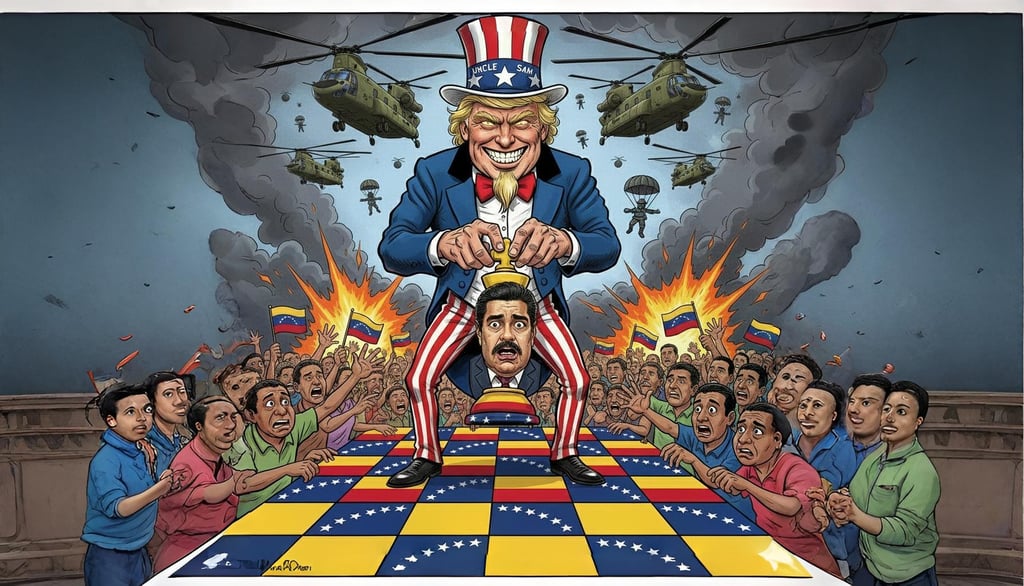

Over the past few months, U.S. policy toward Venezuela has entered an extremely dangerous phase, as the administration of President Donald Trump has shifted from political pressure and sanctions to the direct use of military force, culminating in the arrest of Venezuelan President Nicolás Maduro. The approach Washington has chosen to deal with him raises profound legal, political, and strategic concerns.
No matter how bad any regime may be, historical experience shows that the mere fact that a system is unjust does not make its overthrow by force a wise or legitimate option. Recent American history is filled with examples demonstrating that military intervention to remove “unwanted” regimes often opens the door to chaos rather than stability.
In Afghanistan, the United States spent two decades without succeeding in building a stable state. In Libya, the dictator was overthrown, but the state itself collapsed. As for Iraq, the cost of its invasion in 2003 is still being paid regionally and internationally to this day. In Latin America in particular, previous U.S. interventions have left deep scars in countries such as Chile, Guatemala, and Nicaragua, where attempts to impose change by force led to decades of instability.
The problem lies not only in the potential outcomes, but also in the absence of any clear legal framework governing the actions of the Trump administration. The president has offered no convincing explanation to justify this escalation. The official pretext—“fighting drug traffickers and terrorism”—appears largely unconvincing. Venezuela is not a major source of the drugs ravaging American society, and most cocaine flows associated with it are directed toward Europe. Labeling the leaders of rival states as “terrorists” is not new in history and has often been used to justify military interventions under a false security pretext.
By contrast, recent national security documents point to a more realistic explanation: Washington’s attempt to reassert its traditional dominance over Latin America under the banner of reviving the Monroe Doctrine in a more aggressive form. This approach reflects a worldview that treats the Western Hemisphere as an exclusive U.S. sphere of influence and regards its countries as spaces that can be managed by force when necessary.
But this path carries risks that go beyond Venezuela itself. Illegal intervention, carried out without international authorization or serious domestic debate, gives other major powers a pretext to justify similar behavior in their own spheres of influence. It also threatens to turn Venezuela into an open battlefield, where armed networks do not disappear with the fall of the head of the regime, but instead may spiral out of control and plunge the country into a prolonged cycle of violence.
From a purely pragmatic standpoint, this approach does not appear to serve U.S. interests. Venezuela is a large country with complex social and military structures, and any internal collapse could disrupt energy and food markets, trigger broader waves of migration, and create security vacuums exploited by armed groups operating both domestically and across borders.
There are no easy solutions to the Venezuelan crisis, nor any magic formula to end the suffering of its people. But what is clear is that regime change by force—outside the law and without political legitimacy—more often deepens tragedy rather than resolving it. What the Trump administration is doing today does not threaten Venezuela alone; it undermines the standing of the United States and reproduces historical mistakes for which humanity has paid the price time and again.
Contact me via email
SUBSCRIBE TO MY NEWSLETTER
hello@bilalnouraldeen.com
© 2025. All rights reserved.